PostgreSQL Window Functions: A Fast, No-Fluff Reference
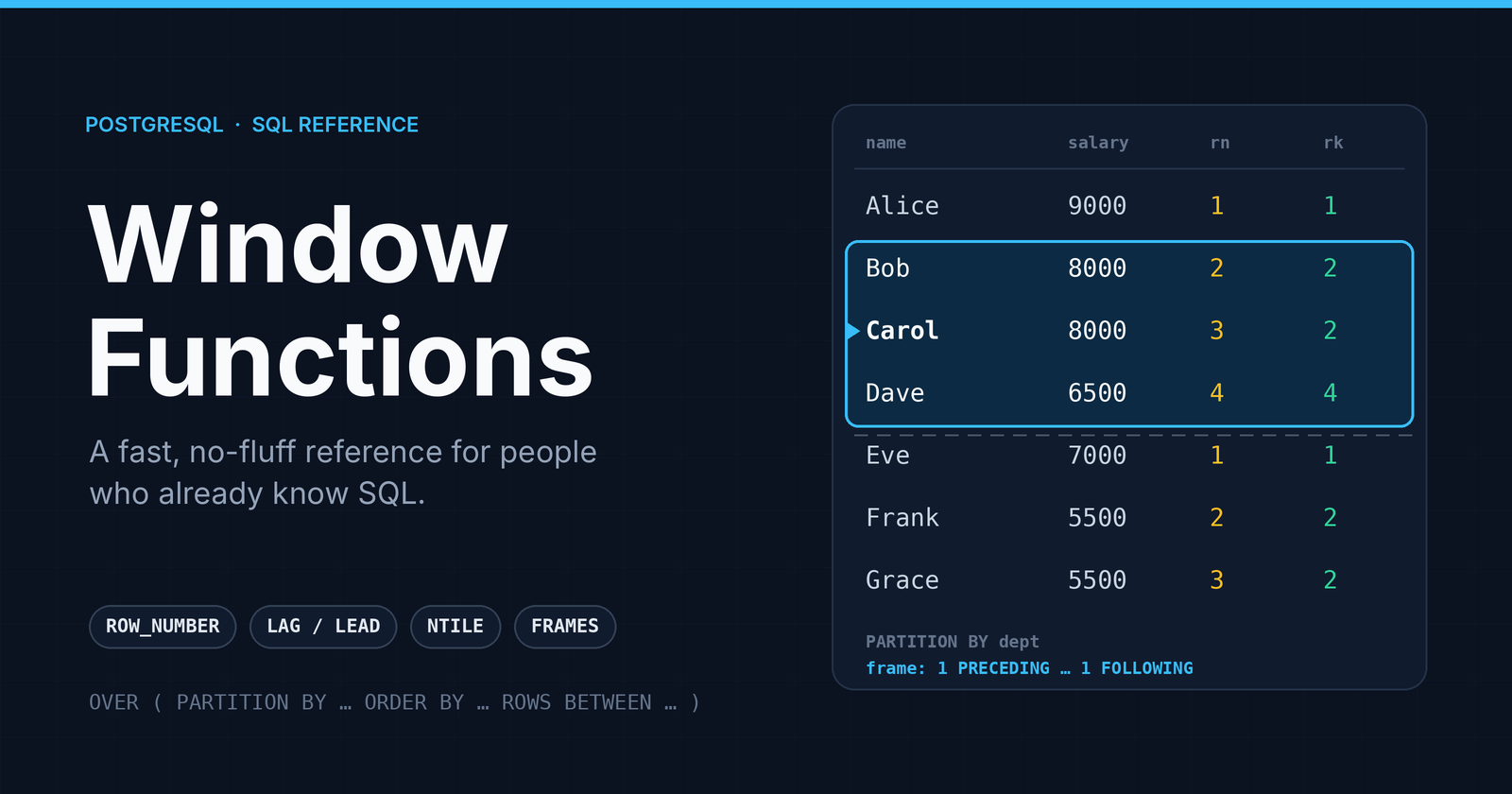
Window functions compute across a set of rows related to the current row without collapsing them like GROUP BY. This post assumes you know SQL. It is a dense reference with one schema and runnable examples.
Schema
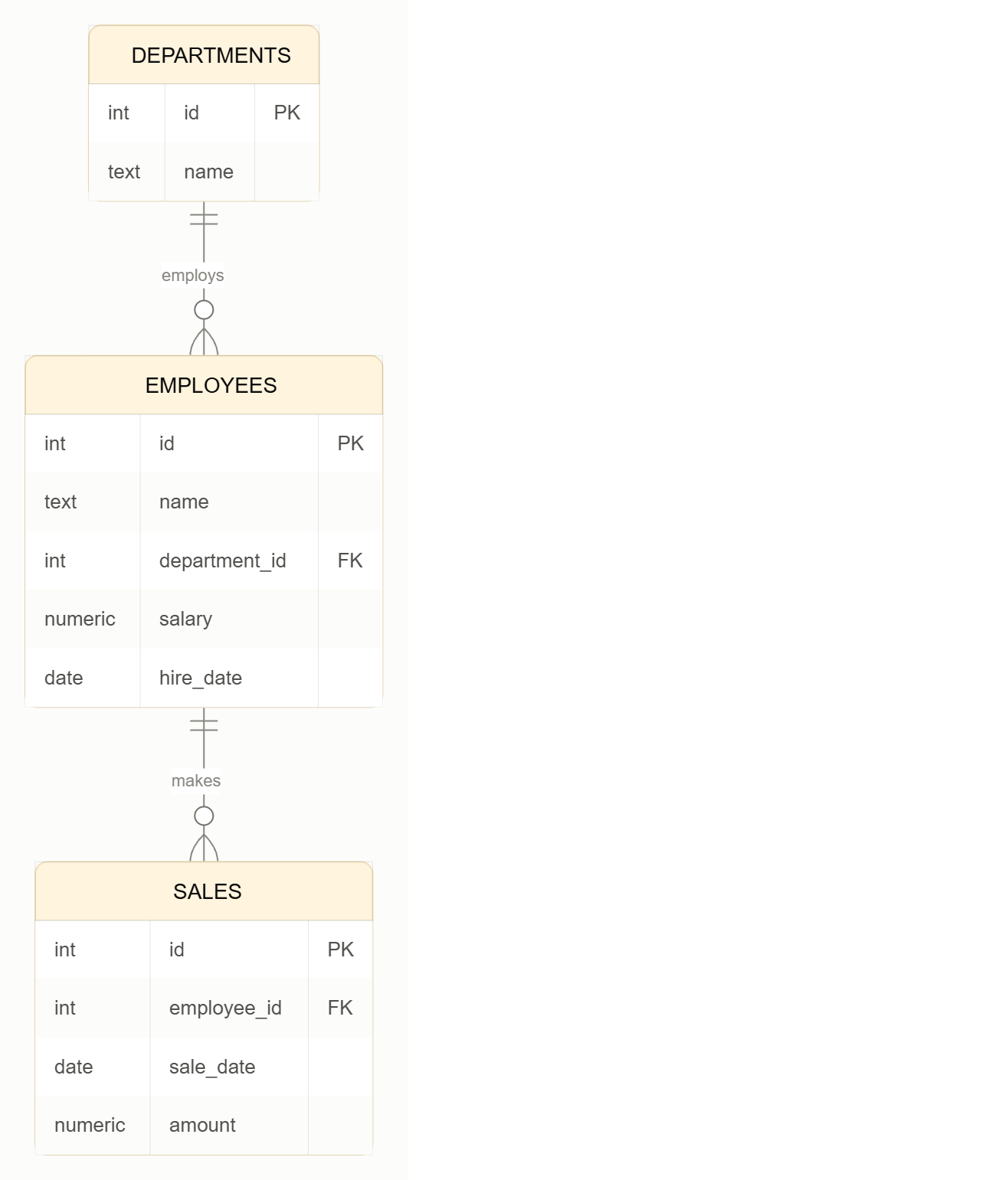
Three tables: departments → employees → sales. Here is a the ER diagram.
CREATE TABLE departments (
    id   SERIAL PRIMARY KEY,
    name TEXT NOT NULL
);

CREATE TABLE employees (
    id            SERIAL PRIMARY KEY,
    name          TEXT NOT NULL,
    department_id INT NOT NULL REFERENCES departments(id),
    salary        NUMERIC(10,2) NOT NULL,
    hire_date     DATE NOT NULL
);

CREATE TABLE sales (
    id          SERIAL PRIMARY KEY,
    employee_id INT NOT NULL REFERENCES employees(id),
    sale_date   DATE NOT NULL,
    amount      NUMERIC(10,2) NOT NULL
);
INSERT INTO departments (name) VALUES
('Engineering'), ('Sales'), ('Marketing');

INSERT INTO employees (name, department_id, salary, hire_date) VALUES
('Alice', 1, 9000, '2020-01-15'),
('Bob',   1, 8000, '2020-06-01'),
('Carol', 1, 8000, '2021-03-10'),
('Dave',  1, 6500, '2022-09-01'),
('Eve',   2, 7000, '2019-11-20'),
('Frank', 2, 5500, '2021-07-05'),
('Grace', 2, 5500, '2022-01-17'),
('Heidi', 3, 6000, '2020-08-12'),
('Ivan',  3, 4800, '2023-02-01');

INSERT INTO sales (employee_id, sale_date, amount) VALUES
(5, '2025-01-10', 1200), (5, '2025-02-14', 1500),
(5, '2025-03-20',  900), (5, '2025-04-18', 1800),
(6, '2025-01-22',  800), (6, '2025-02-25', 1100),
(6, '2025-03-30', 1100), (6, '2025-04-12',  700),
(7, '2025-01-05',  500), (7, '2025-02-08', 1300),
(7, '2025-03-15',  600), (7, '2025-04-28', 1000);
The data has deliberate salary ties (Bob/Carol, Frank/Grace) and repeated sale amounts, so the ranking and frame behavior is visible.
Anatomy
function() OVER (
    [PARTITION BY ...]   -- split rows into groups
    [ORDER BY ...]       -- order within each group
    [frame_clause]       -- which rows around the current row to use
)
PARTITION BYis likeGROUP BYwithout collapsing rows. Omit it and the whole result set is one partition.ORDER BYdefines row order inside the partition. It also changes the default frame (see Frames).- Reuse definitions with a named window:
WINDOW w AS (PARTITION BY ... ORDER BY ...). - Window functions run after
WHERE/GROUP BY/HAVING. You can't filter on them directly. Wrap them in a CTE or subquery. Postgres has noQUALIFY.
Ranking: ROW_NUMBER, RANK, DENSE_RANK
SELECT d.name AS dept, e.name, e.salary,
       ROW_NUMBER() OVER w AS rn,
       RANK()       OVER w AS rnk,
       DENSE_RANK() OVER w AS drnk
FROM employees e
JOIN departments d ON d.id = e.department_id
WINDOW w AS (PARTITION BY e.department_id ORDER BY e.salary DESC);
Engineering result:
| name | salary | rn | rnk | drnk |
|---|---|---|---|---|
| Alice | 9000 | 1 | 1 | 1 |
| Bob | 8000 | 2 | 2 | 2 |
| Carol | 8000 | 3 | 2 | 2 |
| Dave | 6500 | 4 | 4 | 3 |
ROW_NUMBERis always unique. Ties are broken arbitrarily unless you add a tiebreaker toORDER BY.RANKgives ties the same rank and leaves gaps (1, 2, 2, 4).DENSE_RANKgives ties the same rank with no gaps (1, 2, 2, 3).
Top-N per group. Filter in an outer query:
SELECT * FROM (
    SELECT name, department_id, salary,
           ROW_NUMBER() OVER (PARTITION BY department_id
                              ORDER BY salary DESC, hire_date) AS rn
    FROM employees
) t
WHERE rn <= 2;
The same ROW_NUMBER() ... WHERE rn = 1 pattern is the cleanest way to dedupe.
Offsets: LAG and LEAD
SELECT employee_id, sale_date, amount,
       LAG(amount)        OVER w AS prev_amount,
       LEAD(amount)       OVER w AS next_amount,
       LAG(amount, 1, 0)  OVER w AS prev_or_zero,
       ROUND(100.0 * (amount - LAG(amount) OVER w)
             / NULLIF(LAG(amount) OVER w, 0), 1) AS pct_change
FROM sales
WINDOW w AS (PARTITION BY employee_id ORDER BY sale_date);
- Signature:
LAG(expr [, offset [, default]]). The default offset is 1, and the default value isNULL. - The first row per partition gets
NULLfromLAG, and the last getsNULLfromLEAD. - Always guard growth math with
NULLIF(..., 0).
Value functions: FIRST_VALUE, LAST_VALUE, NTH_VALUE
SELECT name, department_id, salary,
       FIRST_VALUE(name) OVER w AS top_earner,
       LAST_VALUE(name)  OVER (w ROWS BETWEEN UNBOUNDED PRECEDING
                                          AND UNBOUNDED FOLLOWING) AS lowest_earner,
       NTH_VALUE(name, 2) OVER (w ROWS BETWEEN UNBOUNDED PRECEDING
                                           AND UNBOUNDED FOLLOWING) AS second_earner
FROM employees
WINDOW w AS (PARTITION BY department_id ORDER BY salary DESC, hire_date);
The classic trap. With
ORDER BY, the default frame ends at the current row. A bareLAST_VALUE(x) OVER (ORDER BY ...)returns the current row's value, not the last one in the partition. Widen the frame toUNBOUNDED FOLLOWING.
NTH_VALUE returns NULL when the frame doesn't yet contain an Nth row. It has the same frame sensitivity as LAST_VALUE.
Aggregates as windows: SUM, AVG, COUNT
SELECT employee_id, sale_date, amount,
       SUM(amount) OVER (PARTITION BY employee_id ORDER BY sale_date) AS running_total,
       AVG(amount) OVER (PARTITION BY employee_id ORDER BY sale_date
                         ROWS BETWEEN 1 PRECEDING AND CURRENT ROW)   AS moving_avg_2,
       COUNT(*)    OVER (PARTITION BY employee_id)                   AS n_sales,
       ROUND(100.0 * amount /
             SUM(amount) OVER (PARTITION BY employee_id), 1)         AS pct_of_total
FROM sales;
- With
ORDER BY, aggregates become cumulative (running totals, running averages). - Without
ORDER BY, they cover the whole partition, which is useful for share-of-total. COUNT(col)skipsNULLs, whileCOUNT(*)doesn't.
Bucketing: NTILE
SELECT name, salary,
       NTILE(4) OVER (ORDER BY salary DESC) AS quartile
FROM employees;
Nine rows into four buckets gives sizes 3, 2, 2, 2. When rows don't divide evenly, the first buckets get the extra rows. NTILE is based on row position, not value, so equal salaries can land in different buckets. Use PERCENT_RANK or CUME_DIST if you need value-aware cutoffs.
Frames
The frame is the subset of the partition the function sees for each row.
{ ROWS | RANGE | GROUPS } BETWEEN <start> AND <end> [ EXCLUDE ... ]
<start>/<end>: UNBOUNDED PRECEDING | n PRECEDING | CURRENT ROW | n FOLLOWING | UNBOUNDED FOLLOWING
Defaults:
| Clause present | Default frame |
|---|---|
ORDER BY |
RANGE BETWEEN UNBOUNDED PRECEDING AND CURRENT ROW |
no ORDER BY |
the entire partition |
The three modes differ in how they treat peers (rows tied on the ORDER BY key):
SELECT name, salary,
  SUM(salary) OVER (ORDER BY salary ROWS   BETWEEN UNBOUNDED PRECEDING AND CURRENT ROW) AS rows_sum,
  SUM(salary) OVER (ORDER BY salary RANGE  BETWEEN UNBOUNDED PRECEDING AND CURRENT ROW) AS range_sum,
  SUM(salary) OVER (ORDER BY salary GROUPS BETWEEN 1 PRECEDING AND CURRENT ROW)         AS groups_sum
FROM employees;
ROWScounts physical rows, so ties are split arbitrarily.RANGEincludes all peers of the current row, so tied rows get the same value. This is why the default running total "jumps" on ties.GROUPS(PG 11+) counts peer groups.
Range with offsets works on dates and intervals, which gives a true time-based rolling window:
SELECT employee_id, sale_date, amount,
       SUM(amount) OVER (PARTITION BY employee_id
                         ORDER BY sale_date
                         RANGE BETWEEN INTERVAL '30 days' PRECEDING AND CURRENT ROW)
         AS rolling_30d
FROM sales;
EXCLUDE CURRENT ROW is handy for "compare to everyone else":
AVG(salary) OVER (PARTITION BY department_id
                  ROWS BETWEEN UNBOUNDED PRECEDING AND UNBOUNDED FOLLOWING
                  EXCLUDE CURRENT ROW) AS avg_of_peers
Cheat sheet
| Need | Use |
|---|---|
| Unique sequence / dedupe | ROW_NUMBER() |
| Ranking with gaps / no gaps | RANK() / DENSE_RANK() |
| Previous / next row | LAG() / LEAD() |
| First / last / Nth in group | FIRST_VALUE / LAST_VALUE / NTH_VALUE (mind the frame) |
| Running total / moving average | SUM/AVG() OVER (ORDER BY ... ROWS ...) |
| Share of total | x / SUM(x) OVER (PARTITION BY ...) |
| Equal-size buckets | NTILE(n) |
| Time-based rolling window | RANGE BETWEEN INTERVAL '...' PRECEDING AND CURRENT ROW |
Performance notes
- A window sort is driven by
PARTITION BY+ORDER BY. An index matching that column order can let Postgres skip the sort. - Windows sharing the same definition are computed in one pass, so use a named
WINDOWclause to make that explicit. - Filter before you window. Fewer rows into the window node means a cheaper sort.
- Check
EXPLAIN (ANALYZE)for theWindowAggnode and any disk-spilling sorts.
Comments
Join the discussionNo comments yet. Be the first to comment.